| Autor: |
Rosales-Martínez, O., Granda-Gutiérrez, E.E., Matías-Mendoza, G.A., García-Hernández, R.A., Flores-Fuentes, A.A. |
| Descripción: |
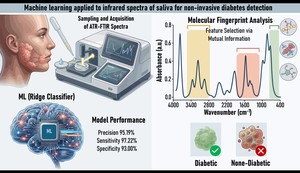
The growing prevalence of type 2 diabetes mellitus (T2DM) demands rapid and non-invasive diagnostic methods. Attenuated total reflectance Fourier-transform infrared (ATR-FTIR) spectroscopy of saliva has emerged as a promising alternative, capable of capturing the "molecular fingerprint" that reflects the individual's metabolic state. We developed and validated a machine learning model to effectively differentiate between individuals with and without T2DM. For this purpose, we used a public dataset of 1040 saliva ATR-FTIR spectra, comprising 540 samples from individuals with T2DM and 500 from non-diabetic individuals. A feature selection analysis based on mutual information was applied to quantify the relevance of each wavenumber and identify the most predictive spectral regions. Subsequently, a Ridge Classifier model was trained using only the subset of features filtered by mutual information score. A molecular fingerprint of T2DM in saliva was identified in three key regions: 450-400 cm⁻¹, 1800-1200 cm⁻¹, and 3600-2800 cm⁻¹. The final classification model demonstrated outstanding performance, achieving an overall accuracy of 95.19%, with a sensitivity of 97.22% and a specificity of 93%. These results indicate that the metabolic alterations of diabetes cause consistent and measurable changes in saliva, positioning ATR-FTIR spectroscopy combined with machine learning as a powerful and viable tool for non-invasive diagnostic support. These findings provide an empirical basis for specialists in biochemistry and molecular biology to conduct future studies aimed at identifying the specific biomolecules responsible for these spectral variations.
Keywords: ATR-FTIR Spectroscopy, Machine Learning, Spectral Biomarkers, Spectral Fingerprint in Saliva, Type 2 Diabetes Mellitus.
|